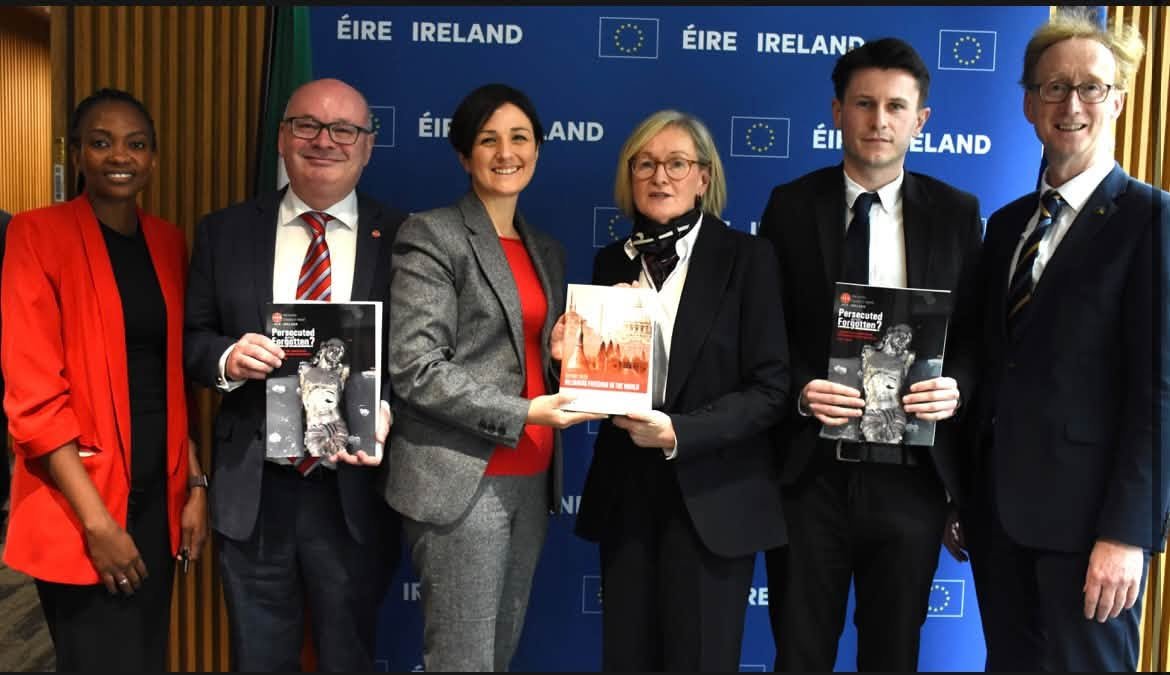
As part of its Week of Witness commemorations, Aid to the Church in Need Ireland invited EU Special Envoy for the Promotion of Freedom of Religion or Belief outside the European Union and former Vice-President of the European Parliament, Mairead McGuinness, to speak to a gathering of politicians and journalists about ACN’s recently published report, Persecuted and Forgotten?
Throughout her speech, Ms McGuinness acknowledged the far-reaching effects of Christian persecution around the world and committed to prioritising the issue both in her capacity and institutionally in the EU.
Speaking in the European Parliament Liaison Office in Dublin on Red Wednesday, Ms McGuinness lamented the worsening Christian persecution detailed in ACN’s report and said that the Christians who experience persecution around the world must be listened to by those in positions to speak out in the west.
“The sad reality is that this type of discrimination and persecution of faith is not a thing of the past at all,” she said. “There are far too many minority faith groups literally living the reality of what was experienced centuries ago in this country. The centuries are different but the fear and consequences are the same.
“The one thing that has struck me in the few months I’ve been in this role is when I meet groups, and yesterday I met groups from North Korea and Pakistan, it’s the fear behind their stories and telling their stories but also their need to be heard and need to be listened to.”
Highlighting case studies of Christian victims of persecution that are contained in the report, Ms McGuinness said she could scarcely believe the treatment of some Christians, who are scapegoated, abducted, attacked, and sometimes killed for their faith.
“The report shows that there’s terrible and unnecessary suffering around the world, she said. “The direction of travel this report shows, and it covers 18 countries and in more than half of them the situation is worse than it was two years ago with 220 million Christians being exposed to persecution, that it’s going in the wrong direction.
“In the case of Solomon Ako, could you imagine a situation because of your faith, being jailed, chained, beaten, and being told to give up your faith? But also to have the courage and the bravery to say no.”
Commending ACN’s day of advocacy for persecuted Christians, Red Wednesday, and the work the papal charity does with persecuted Christians around the world, Ms McGuinness said that she was sure that those experiencing Christian persecution are grateful for the efforts of ACN, for bringing their stories to light in environments where they cannot.
“Red Wednesday has particular resonance, she said. “It’s a week when attentions are paid to the very difficult situation around the world that many Christians face in practising their faith. I would say to ACN that you do a great service to the people who are not in this room and who are not free and in fact who could not be in this room because of their faith, but I’m sure they know that because you reached out to many who are in very dark places.”
Committing to concrete action that helps persecuted Christians outside of the EU, Ms McGuinness recognised her limitations around direct involvement in specific cases, but assured those present that those with decision-making faculties in the EU are made aware of the horrors some Christians are facing in countries where they have a minority presence and are also kept reliably informed of the developments driving Christian persecution around the world.
“I know that in my role as envoy, I can’t directly open a prison door or stop a militia, but I can make sure that what you have documented is heard where decisions are made both in Brussels and elsewhere and that’s why I’m particularly grateful for a detailed report such as these but more importantly for being in the room with you, because presence is so very important and it allows us to have conversations both before and after meetings,” she said.
“I hear very clearly a sense that Christians from outside the west feel that the west doesn’t hear them and I think we have to hear that with open ears and be aware of it – to listen better and act more effectively.”
According to Ms McGuinness, the real work takes place after events like ACN Ireland’s Persecuted and Forgotten? Report launch, when people have gone home and the subject has been forgotten about. Ms McGuinness said that the only way to effect meaningful change is to put sustained attention on the issue, long after the meeting has come to an end.
“This week is a week in which you have an opportunity and you’ve done that by highlighting the real-world situation of Christians around the globe whose voices cannot be heard if you did not speak for them,” she said. “It’s the after action when the lights go off that will really make a difference.
“I think the title of this report… persecuted, that’s a sad reality. I think the question-mark after forgotten, that’s up to us. It’s up to everyone who feels deeply about this topic to talk about it and engage with it – to speak up about it.”
Homing in on the words ‘human rights catastrophe’ which ACN uses to describe the current situation for Christians facing persecution, Ms McGuinness said that these words shocked her as the right to practise our faith, afforded to us in the west, makes the conditions some Christians face around the world because of their faith downright unbelievable.
“To hear that this is a human rights catastrophe unfolding for Christians is quite a sentence in the world of 2026,” she said. “In places like Ireland and all over the west, we have freedoms and we presume this is the norm for the rest of the world. I said to a colleague recently that we are the exception, not the norm.
“I think that this report is certainly capturing all of that. Hatred is a very, ugly, powerful word and we need to understand what is at the core of humanity where hatred prevails and people feel empowered to attack somebody who doesn’t share their faith. It’s something that’s so staggering to think of.”
Reflecting on the role of institutions like the EU, Ms McGuinness said that the key takeaway is if major organisations like the EU are doing enough to tackle the issue.
“I hope that those you report on and the wider issue, that they don’t continue to feel hopeless and trapped and that they realise that we are listening and we are acting but I think your challenge to us is are we doing enough and are we effective?,” she said.