Paschal hope among the ruins in Gaza
Holy Week has begun against a backdrop of persistent war and shortages in the Catholic compound in Gaza. Despite everything, the community intends to celebrate Easter to the full, sustained by a prayer for peace throughout the Middle East, as Fr Gabriel Romanelli explained to the Catholic charity, Aid to the Church in Need (ACN).
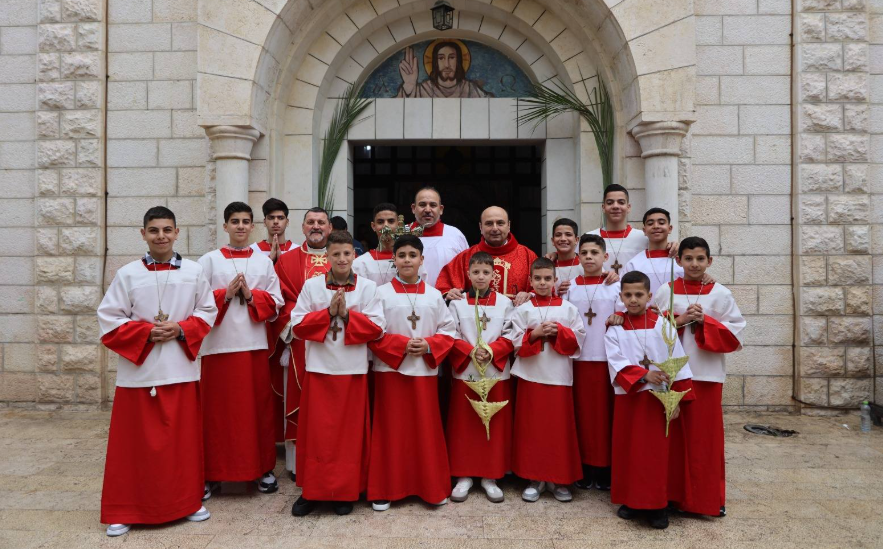
As the Feast of the Resurrection approaches, nothing is entirely certain regarding the form of the various celebrations that will take within the Holy Family parish. War still dictates the pace of daily life in Gaza. Despite the uncertainties, the parish has swung into action: "We have prepared with the altar servers to celebrate the whole of Holy Week with the full liturgy”, Fr Gabriel Romanelli told ACN.
The schedule of celebrations will depend on the security situation. "We will have to evaluate the danger every day," said the parish priest of the only Catholic parish in the Palestinian enclave. While shelling is now less frequent, it has not ceased. In the event of a threat, celebrations will be held inside the church, but for Fr Gabriel, the essential point "is first and foremost about remembering Jesus, His pain, and His redeeming love, so that we too may offer our suffering for the redemption of all and for peace in Gaza, Jerusalem, throughout Palestine, Israel, Lebanon, Iran, the Gulf countries, and the entire Middle East."
A living liturgy in the heart of adversity
On 29 March, the celebration of Palm Sunday, evoking Jesus' entry into Jerusalem, took place amid a tense atmosphere and under rain, ACN has learned. "There was a lot of gunfire along the yellow line [the Israeli military limit established during the October 2025 ceasefire], with fragments of shrapnel landed on our roof," said Fr Romanelli.
Due to the danger, and following several attempts, the parish had to abandon the idea of decorating the cross overlooking the church with palm branches. The frame supporting it still bears the scars of shelling, though the cross itself remained intact. It would have been a powerful symbol with Easter approaching. Against all odds, however, the Palm Sunday procession was able to take place outside in the parish courtyard before the Mass.
The rites of the Easter Triduum are expected to be maintained, with adaptations imposed by circumstance. On Holy Thursday, 12 men chosen from among Catholic and Orthodox families will participate in the Washing of the Feet, a sign of ecumenical unity in times of trial, even though, this year, the Orthodox will be celebrating Easter one week later than Catholics in Gaza.
Lack of time and energy have prevented the customary reenactment of the Passion of Christ on Good Friday, but a funeral procession with the "Burial of Christ" is planned after the Liturgy of the Passion. The faithful will process to the small cemetery located next to the church, in a gesture of remembrance for all those who have died in the war, and particularly for those from the Orthodox and Catholic parishes in Gaza.
The Gazan Christian community has paid a heavy price for the conflict: nearly 6% of its members have lost their lives, totalling 60 souls. Among them, 23 people died due to shelling or snipers, another 23 due to a lack of medical care, and a further 14 due to old age in conditions worsened by the war.
On Holy Saturday, the Easter Vigil will be celebrated in all its liturgical richness. However, the material signs of the feast will show the shortages. In the absence of traditional incense sachets, holy water will be distributed, along with a few chocolates that the parish is trying to obtain "at any price," as they did at Christmas, as a symbol of Paschal joy.
"Let us hope that the entire Holy Land can rejoice in the Lord's Passover and that the Lord will grant us the end of this terrible war and the opening of borders so that medical supplies can be delivered," the missionary priest urged in his conversation with ACN.
Between humanitarian crisis and signs of resurrection
Furthermore, "it is still difficult to obtain large scale shipments of the material required to rebuild homes: there is a lack of glass, wood, cement, cables, iron, electrical installations and water systems," Fr Gabriel lamented.
Today, most of the Christian refugees have left the parish grounds to try and rebuild their lives. Families have returned to what remains of their homes or have found refuge in abandoned, borrowed, or rented housing, often in extremely precarious conditions. But "the fact that they have begun trying to live outside the parish gives them more strength," Fr Gabriel Romanelli observed.
The parish itself remains the heart of support and stability: children are there in the morning for school, then in the afternoon for prayer activities. And since spaces have been freed up in the school by the refugees, the parish is beginning to welcome Muslim pupils again, as it did before the war in the Latin Patriarchate of Jerusalem schools in Gaza.
Support Our Mission
Help Christians in Need
We support projects in over 5,000 communities around the world in an effort to create a world in which Christianity can thrive. In 2025, we were able to support 5,368 projects in 141 countries worldwide.
Donate Now